















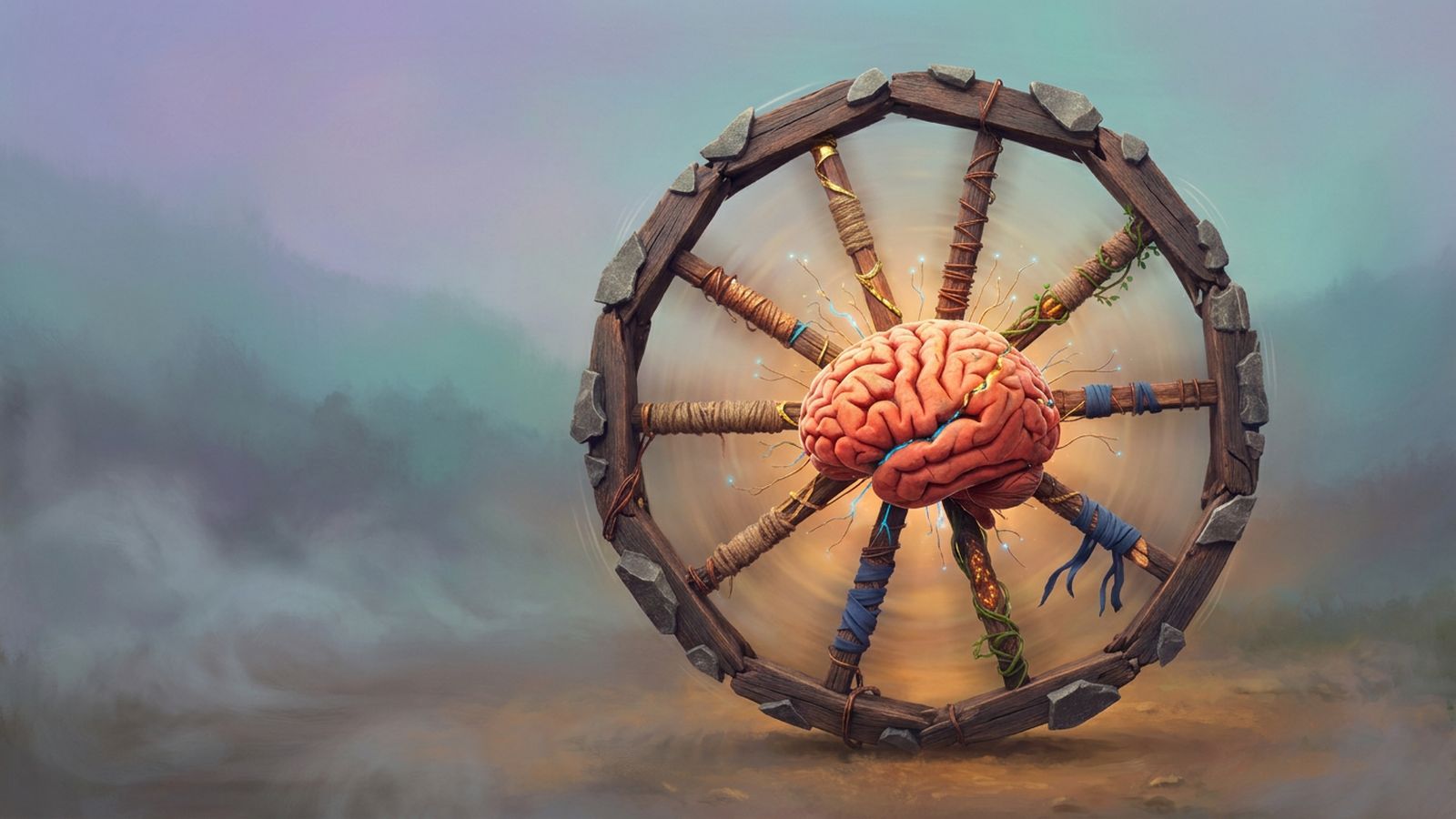


The Autonomic Wheel
Learning to Drive Your 300,000-Year-Old Body
Robert Fuge · The Long Road
The whole book in one journey: a 300,000-year-old body, the road it woke up on, and how to drive it.
Preface
Something is wrong with me.
Maybe you've never said it out loud. You're bone-deep tired: white-knuckling ordinary days, crashing in ways you can't predict, burning twice the energy just to stand still. What if nothing is wrong with you, and a lot is wrong with the road?
Chapter 1 · 300,000 years ago
The road you were built for.
A small band, a long quiet, and a sun that set the clock. Your nervous system was tuned on this road. Rest was the default. Alarm was the exception.
Chapter 2
A new map of self.
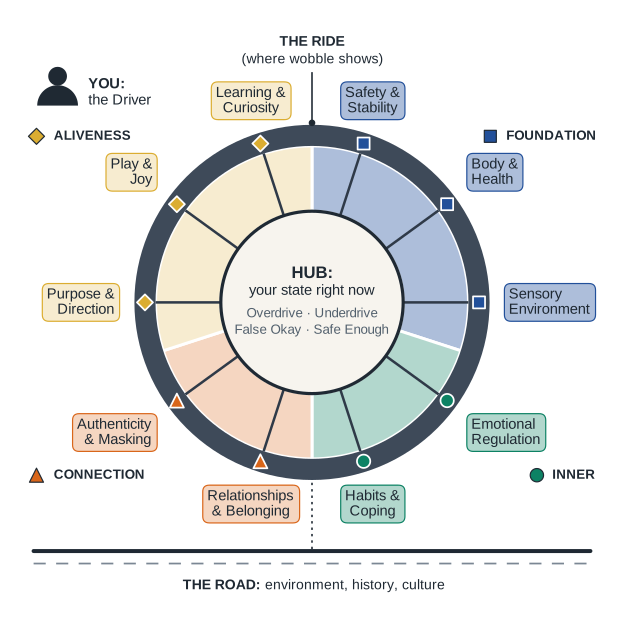
Your nervous system is the vehicle. Your environment is the road. Your conscious mind is the driver, and the GPS. And how the ride feels, smooth or jerky, is your wheel.
Chapter 3
Wobbly wheels.
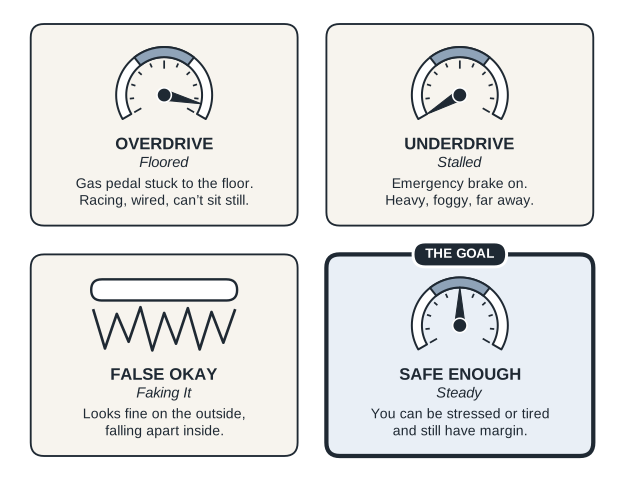
Mornings ruined before you're out of bed. Afternoons where three hours vanish. Too wired to rest, too tired to function. That's wobble: a system rolling on uneven spokes.
Chapter 4
The smoke detector.
Your brain's core job is prediction. One rustle in the grass and everything fires: heart up, breath fast, blood to the legs. It was built for short bursts. Now the rustles never stop.
Chapter 5
Emergency duct tape.
When the wobble gets unbearable, you grab whatever brings fast relief. Dopamine is the duct tape: it holds the wheel together tonight, and pulls paint off the spokes over time.
Chapter 6
Your chemical orchestra.
It's never just one molecule. Your nervous system is an orchestra, not a soloist. When it plays out of tune, that isn't weakness. It's a crowded pit under strain.
Chapter 7
The night shift.
Sleep is one of the biggest levers on your wheel. For most of history the night came with real dark, a banked fire and bodies close by. Your system still listens for those signals.
Chapter 8
Talking to the old system.
Your nervous system doesn't understand “calm down.” It understands breath, posture, warmth, rhythm and touch. Body-first tools speak its language.
Chapter 9
Updating the GPS.
The voice narrating every bump isn't the truth. It's a GPS running old maps. You can update it without gaslighting yourself.
Chapter 10
Changing the road.
No driver stays steady on a road full of potholes, glare and sirens. You're not just a self to improve. You're a body in a place. Healing is also architectural.
Chapter 11
You don't drive alone.
Your nervous system reads other nervous systems all day long. Safety was never just a thought. It was a body sitting next to yours.
Chapter 12
Mapping your own wheel.
This is where the model stops being interesting psychology and becomes: here's what my wheel looks like, right now.
Chapter 13
Different wheels.
Autistic, ADHD, trauma-shaped, highly sensitive, chronically ill. Your wheel isn't wrong. The road was built for a different one.
Chapter 14
Nails in the wheel.
Some things aren't wobbles. Loss, illness, limits you can't positive-think away. You can learn to drive with a nail in the wheel, and stop blaming yourself for the bump.
Chapter 15
Three months of road.
Not a bootcamp. Driver's lessons for your specific wheel: one or two spokes, a small menu of tools, a bare-minimum plan for bad days.
Final chapter
Hands on the wheel.
You can't trade the body in. But you can learn to drive it, kindly, on the road you're actually on. The Autonomic Wheel is the manual it never came with.
Six months from now
Six months from now.
Wobbling a little less. Crashing a little softer. Coming back a little faster. Still on the long road, and no longer driving it alone.
You’re not broken.
You’ve been running over capacity.
Preface
If you’ve picked up this book, there’s probably a quiet thought somewhere in you:
“Something is wrong with me.”
This book starts somewhere other than “fix yourself.” It begins with a single premise:
You are not a broken modern person. You are a 300,000-year-old nervous system trying to function in a world that was built yesterday.
Contents
- Your 300,000-year-old nervous system
- A new map of self
- Wobbly wheels
- Why your wheel wobbles
- Emergency duct tape
- Your chemical orchestra
- The night shift
- Talking to the old system
- Updating the GPS
- Changing the road
- You don’t drive alone
- Mapping your own wheel
…and four more, plus the charts.
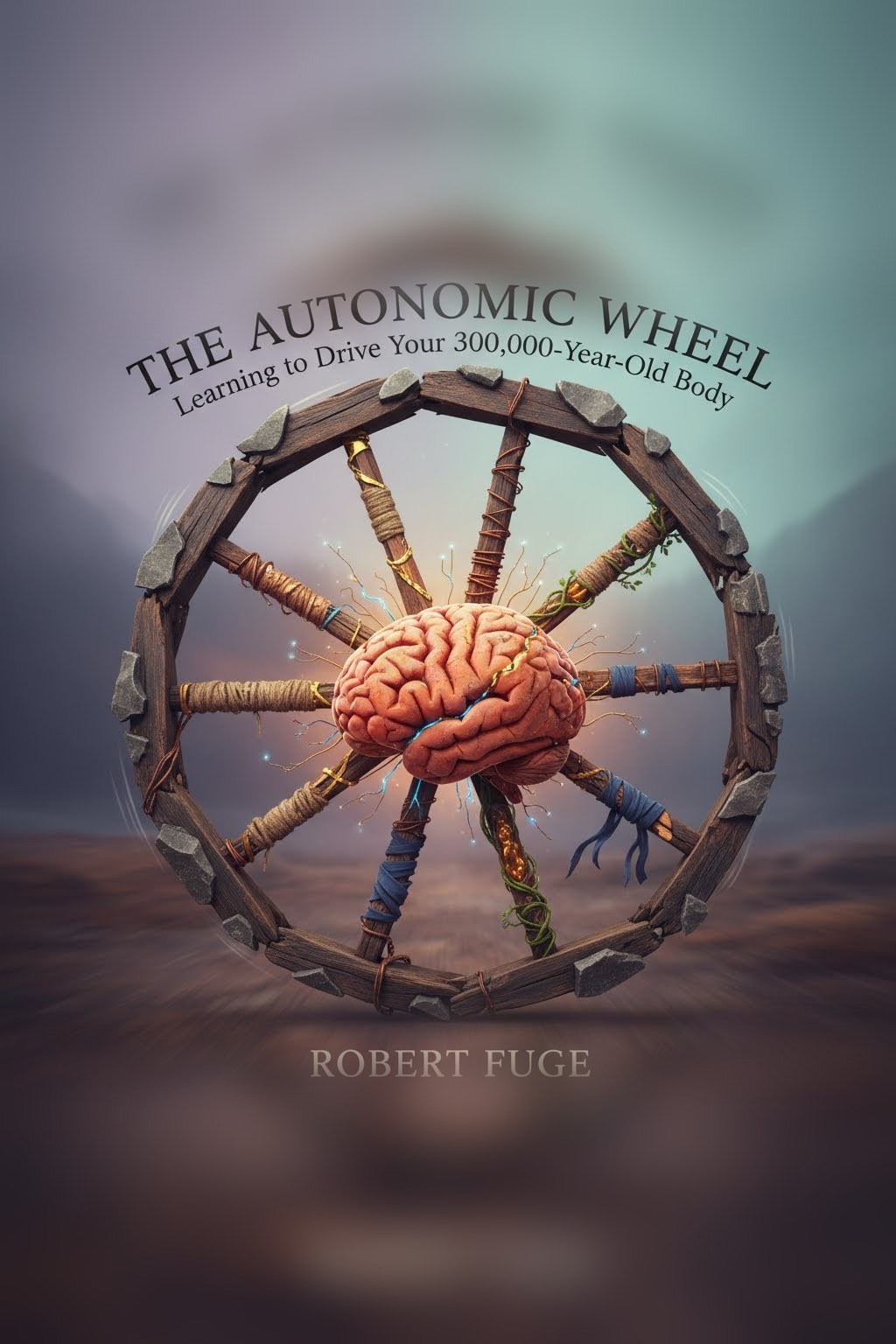
The Autonomic Wheel
Learning to Drive Your 300,000-Year-Old Body
Robert Fuge
A new book · Coming soon
The whole road, in one book.
A new book · Coming soon
The Autonomic Wheel
Learning to Drive Your 300,000-Year-Old Body
by Robert Fuge